Voice Assisted Flight Booking for Tier 2/3 Users

Travel
Consumer Product
Interaction Design

How designing for assurance, not instruction, opened up India's next billion flight bookers.

Voice Assisted Flight Booking for Tier 2/3 Users

Travel
Consumer Product
Interaction Design

How designing for assurance, not instruction, opened up India's next billion flight bookers.

+0%
+0%
+0%

Tickets Booked

Tickets Booked

-0%
-0%
-0%

Drop-off Rate

Drop-off Rate

+0%
+0%
+0%

SEO traffic from Tier 2/3 cities

SEO traffic from Tier 2/3 cities

-0%
-0%
-0%

Post-booking customer care calls

Post-booking customer care calls

COMPANY

MakeMyTrip

MakeMyTrip

MY ROLE

Lead Experience and Interaction Designer

Lead Experience and Interaction Designer

TEAM

Research, Product, Dev, Payment UX

Research, Product, Dev, Payment UX

DELIVERABLE

End-to-end booking flow + voice system

End-to-end booking flow + voice system

The Problem

A product built for urban, English-literate users was failing a new majority

India's Tier 2/3 cities came online during COVID. MakeMyTrip's booking flow assumed fluency: with Latin script, multi-step digital forms, and the conventions of booking interfaces. For this new demographic, the barrier was not willingness. It was cognitive and linguistic overload.

"These users did not need training. They needed assurance."

This reframe, surfaced through research, shaped every design decision that followed.

The Problem

A product built for urban, English-literate users was failing a new majority

India's Tier 2/3 cities came online during COVID. MakeMyTrip's booking flow assumed fluency: with Latin script, multi-step digital forms, and the conventions of booking interfaces. For this new demographic, the barrier was not willingness. It was cognitive and linguistic overload.

"These users did not need training. They needed assurance."

This reframe, surfaced through research, shaped every design decision that followed.

research

The insight came from watching how people used their phones, not the product

We ran online and in-person user interviews with 9 participants from Kanpur and Jaipur, asking them to complete the existing booking flow and then discussing their everyday technology use.

Two observations shaped the design direction:

Users habitually used Google voice search to avoid spelling. Not because they could not type, but because voice was faster and more confident.

They had already used voice-assisted registration for COVID vaccination with ease. Voice was not new to them. The cognitive load of the existing interface was.

research

The insight came from watching how people used their phones,not the product

We ran online and in-person user interviews with 9 participants from Kanpur and Jaipur, asking them to complete the existing booking flow and then discussing their everyday technology use.

Two observations shaped the design direction:

Users habitually used Google voice search to avoid spelling. Not because they could not type, but because voice was faster and more confident.

They had already used voice-assisted registration for COVID vaccination with ease. Voice was not new to them. The cognitive load of the existing interface was.

Design Decisions

Three principles, each earned from research

01

One decision at a time

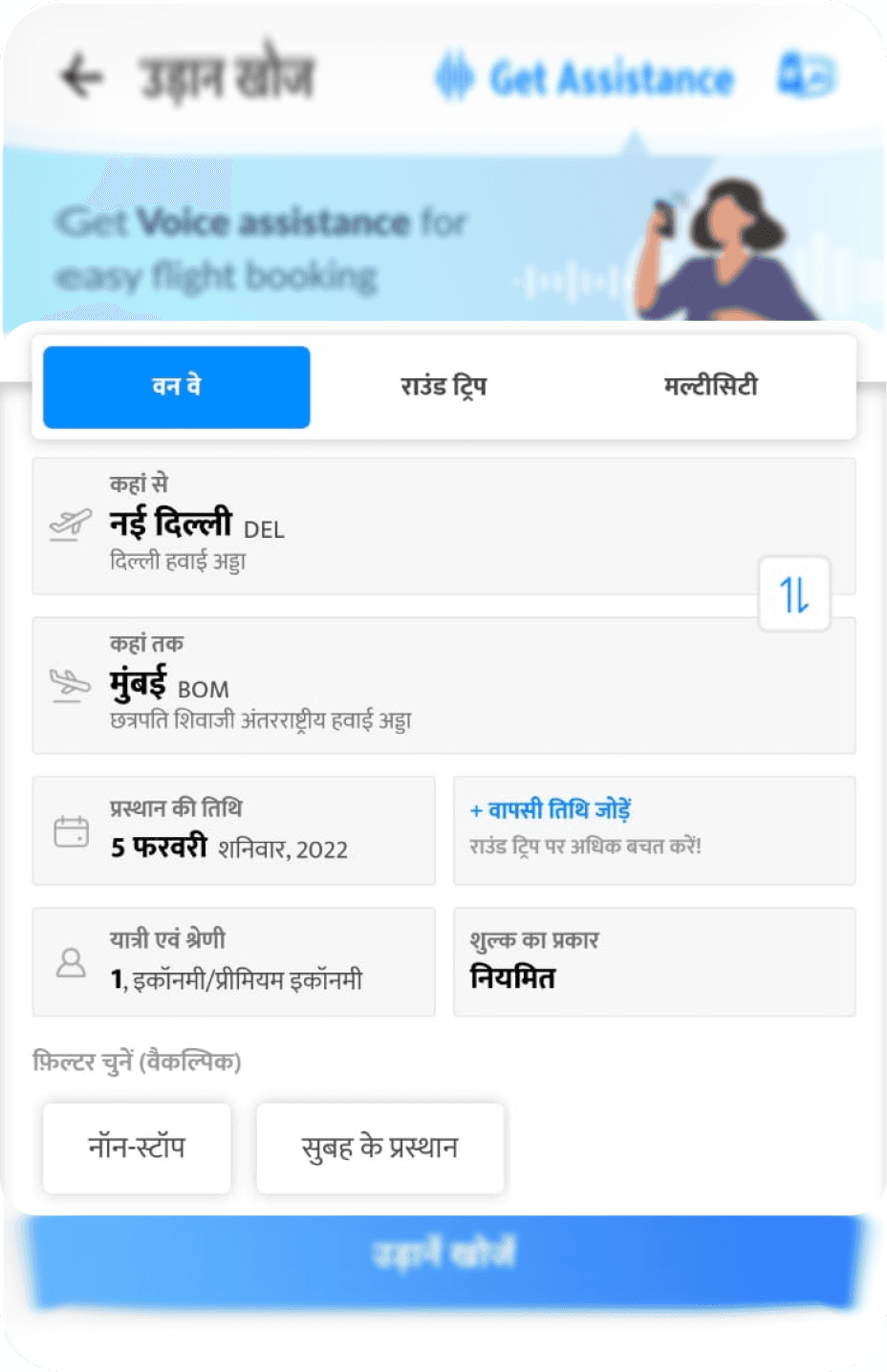
The existing flow demanded simultaneous field processing. We redesigned for sequential interaction: one step confirmed before the next begins.

02

Voice as assurance, not novelty

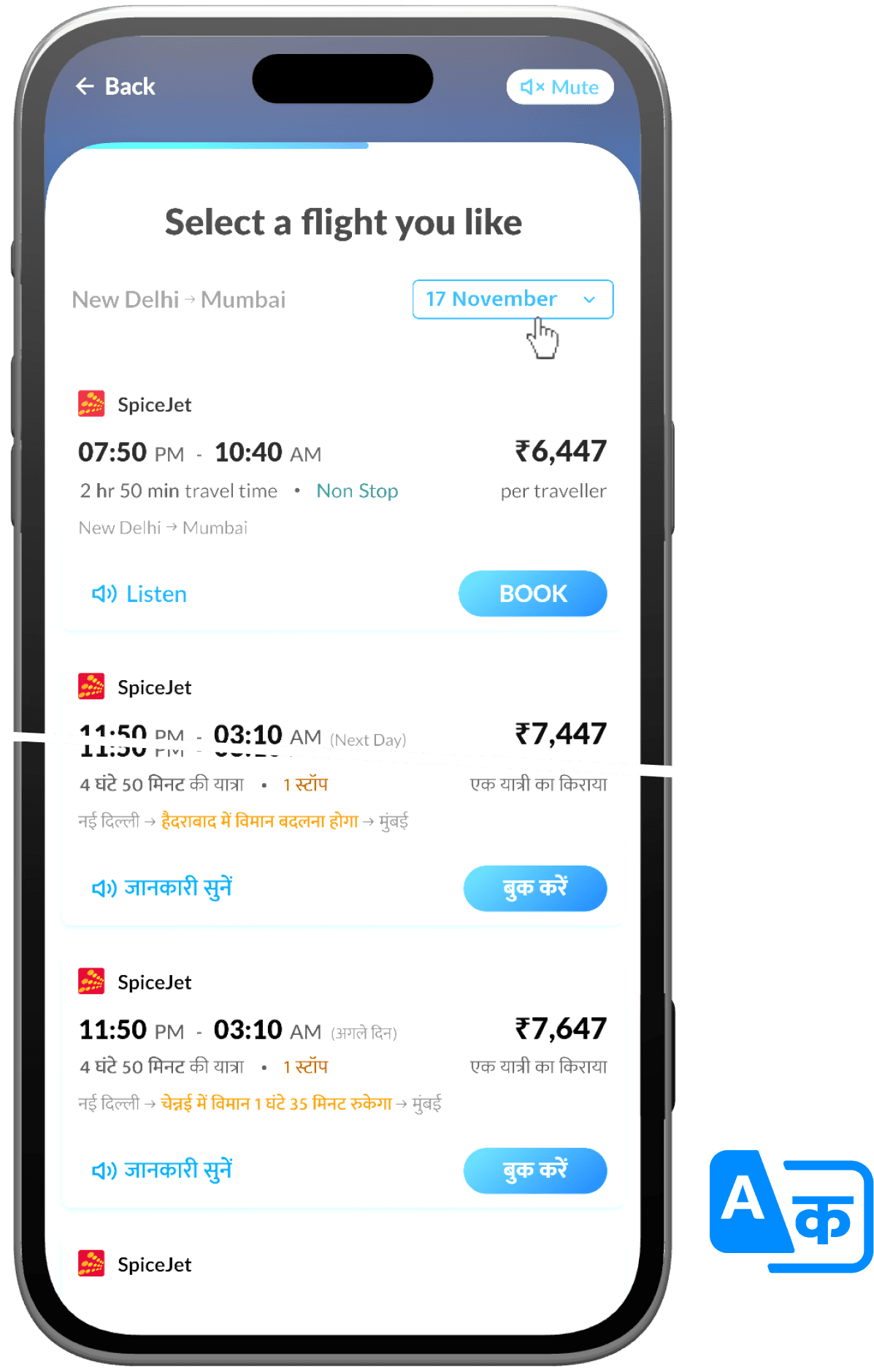
The voice layer reads the page, confirms each step, and reduces anxiety around irreversible financial decisions made in a second language.

03

A mix of Hindi & English

The full flow was designed in Hindi (as it is spoken not written) with Vernacular UX copywriters. Of all decisions, this had the highest leverage on user confidence.
testing and findings

Pre-Release in target cities.

User interview were not possible due to time constraint, so as an alternate, quantitative data from a controlled release was analysed to identify the following changes.
01

One decision at a time

The existing flow demanded simultaneous field processing. We redesigned for sequential interaction: one step confirmed before the next begins.

Before

After

02

Sequential Search: Visual Confusion

The source and destination search steps were visually identical. Users could not tell them apart, confirmed by product team data. The second step was redesigned to be visually distinct.

Before

After

03

03

Voice Input: Preferred Over Typing

Voice Input: Preferred Over Typing

Users found voice input faster, lower effort, and less prone to error. The validation came from behaviour, not just preference.

Users found voice input faster, lower effort, and less prone to error. The validation came from behaviour, not just preference.

04

04

Listing Readback: Closing the Assurance Gap

Listing Readback: Closing the Assurance Gap

Voiced readback of booking details gave users the confidence to confirm. This directly addressed the anxiety around irreversible financial commitment.

Voiced readback of booking details gave users the confidence to confirm. This directly addressed the anxiety around irreversible financial commitment.

outcome

The metrics confirmed the design hypothesis

The customer care call reduction was the most telling result. It confirmed that the problem was never users' ability to book. It was their confidence that they had booked correctly. Designing for that distinction is what the metrics reflect.

+0%
+0%
+0%

Tickets Booked

Tickets Booked

-0%
-0%
-0%

Post-booking customer care calls

Post-booking customer care calls

-0%
-0%
-0%

Drop-off Rate

Drop-off Rate

+0%
+0%
+0%

SEO traffic from Tier 2/3 cities

SEO traffic from Tier 2/3 cities

Create a free website with Framer, the website builder loved by startups, designers and agencies.