


Aim of this case study
This case study focuses on the service design and planning aspects of the project. The final Framework and Toolkit is present on the LCC Changemaker’s official website: View here
The Project: Introduction
Evaluation Framework for Student Partner Programmes
The Situated Evaluation Framework (SEF) provides a participatory framework for student partners and their supervisors to support meaningful and reflective evaluation of their initiatives, intended to be used flexibly and collaboratively. This framework is designed for the Changemaker student partner programme at London college of Communication, University of the arts London.

Traditional Evaluation Methods

Student partners are only contacted towards the end of the programme for evaluation and are assumed to remember their entire journey.
Traditional Evaluation Methods

The Evaluation is designed from an external point of view, only extracting information and privileging written response.
Situated Evaluation Framework

SEF works with student partners to surface lived experiences and speculate future at different touchpoints of their journey.
Situated Evaluation Framework

Knowledge is situated, understood from inside out, embracing diverse forms of creative expression with in-person activities and 1-to-1 sessions with the supervisor.
COMPANY
MY ROLE
TEAM
OUTCOME
Navigation Overview
01 The Problem
An evaluation system that was measuring the wrong things and the ecosystem that revealed why.
02 Rethinking Evaluation
What Students as Partners (SaP) theory asks for, and where the existing methods fall short.
03 The Plan
From stakeholder mapping to feasibility to funding and how the framework was scoped.
04 The Design
Process, principles, and the cognitive logic behind every activity.

01
The Problem
Problem Statement
Design an evaluation method that effectively captures the full impact of student partnership work.
Why evaluation matters?
Evaluation is not just measurement. For the Changemakers programme, it determines what gets funded, what gets reported upward, and what gets seen by the institution at all. Without it, the work is invisible.
The current method
The existing method was a survey, administered at the end of the programme. It captured what student partners could remember, not what they had lived through. And it was built entirely around institutional categories: outputs, reach, deliverables.
The Ecosystem Map

Mapping the programme revealed it was running two parallel systems. One was institutional: fixed, hierarchical, and metrics-driven. The other was negotiated: genuine collaborations built on trust with library staff, info centres, and other spaces outside the formal structure. Visible to the people inside it, invisible to the institution.
Two issues surfaced
The institution treated "student partner" as a flat category. But student partners were doing researcher work, bridge work, translation work between the student body and academic staff. That labour was real, significant, and completely uncounted by the evaluation.
Because the evaluation only measured institutional outputs, student partners were gradually shaping their projects toward what would be counted. The work that made partnership meaningful was precisely what the survey could not see. And so it was not rewarded, not reported, and over time, not done.
Invisible Labour
Participation rates
Student satisfaction
Learning outcomes
Number of students involved
Curriculum changes implemented
Improvements in module evaluations
Alignment with institutional learning and teaching priorities
Administered retrospectively, at a point when respondents may not benefit from any resulting change.
What it could not see
Negotiating disagreement with academic staff
Building trust among participants
Supporting hesitant students
Challenging assumptions about teaching
Complex, emotional and relational experiences
These activities may be central to the success of the partnership, yet they rarely constitute evidence within institutional evaluation.
02
Rethinking Evaluation

Starting with the foundation, the UK Quality code of Higher Education that adopted from Student as Partner theory which highlights qualitative evidence: reflection, dialogue, shared meaning-making. Thus, we approached evaluation as a process that timely surfaces and record lived experience rather than an end of the terms survey.
Keeping inline with SaP, evaluation should be participatory, where the lived experiences would be surfaced through designed activities, mapping student partner’s input and the output of the activity as well.
The full framework outlines seven approaches that shape this: Situated in Lived Experiences · Creative Expression · Collective Reflection · Speculative Thinking · Positionality · Multiple Perspectives · Adaptable
Read about our approach (Opens a new window)
03
The Plan

The Direction : Survey to Situated
The decision was to move away from text-based, end-of-programme surveys toward situated, in-person participatory workshops distributed across the programme timeline. Three touchpoints: one at the beginning, one in the middle, one at the end. Each paired with a 1:1 supervision session.
Why Three Touchpoints
A single end-of-programme survey asks student partners to surface all of their lived experience at once, retrospectively. That is not how memory or reflection works.
Each touchpoint meets partners where they are: onboarding captures what they are carrying into the role, midway captures how they are navigating it, and both scaffold the debrief, where the full arc becomes visible.
Stakeholder Mapping


Why?
As, SEF focused on collective reflection and discussion, we mapped stake holders based on amount of contact in 2 bands, to get an idea of who can be involved in this “collective”.
Outcome
Considering, the discovery and testing phase of SEF as well as the scheduling effort with band 2 and 3, the current phase of SEF would be designed around band 1, with future plans to expand beyond.
Feasibility Mapping
Consideration: Facilitation skills are needed for designed activities.
Outcome: SEF would include a facilitation guide and toolkit, so the framework could operate independently of its designers.
Consideration: Student partner are contracted on hourly basis, with limited numbers in a week. The evaluation activities would need compensate student partners for their participation.
Outcome: The number of hours required would need to be calculated.
Consideration: Extra hours outside of the contract might clash with a other prioritise on the other hand, if SEF activities are mandated by contracted hours, they would take time away from other projects.
Outcome: SEF activities must also directly benefit or support student partner’s work outside the evaluation.
Service Blueprint
To understand the actual time cost of the framework, the team mapped the full service: prep, in-person sessions, 1:1 conversations, analysis, and redesign between touch-points. The blueprint confirmed how many hours the framework would require per touchpoint, across every person involved, including facilitators and supervisors, not just student partners.
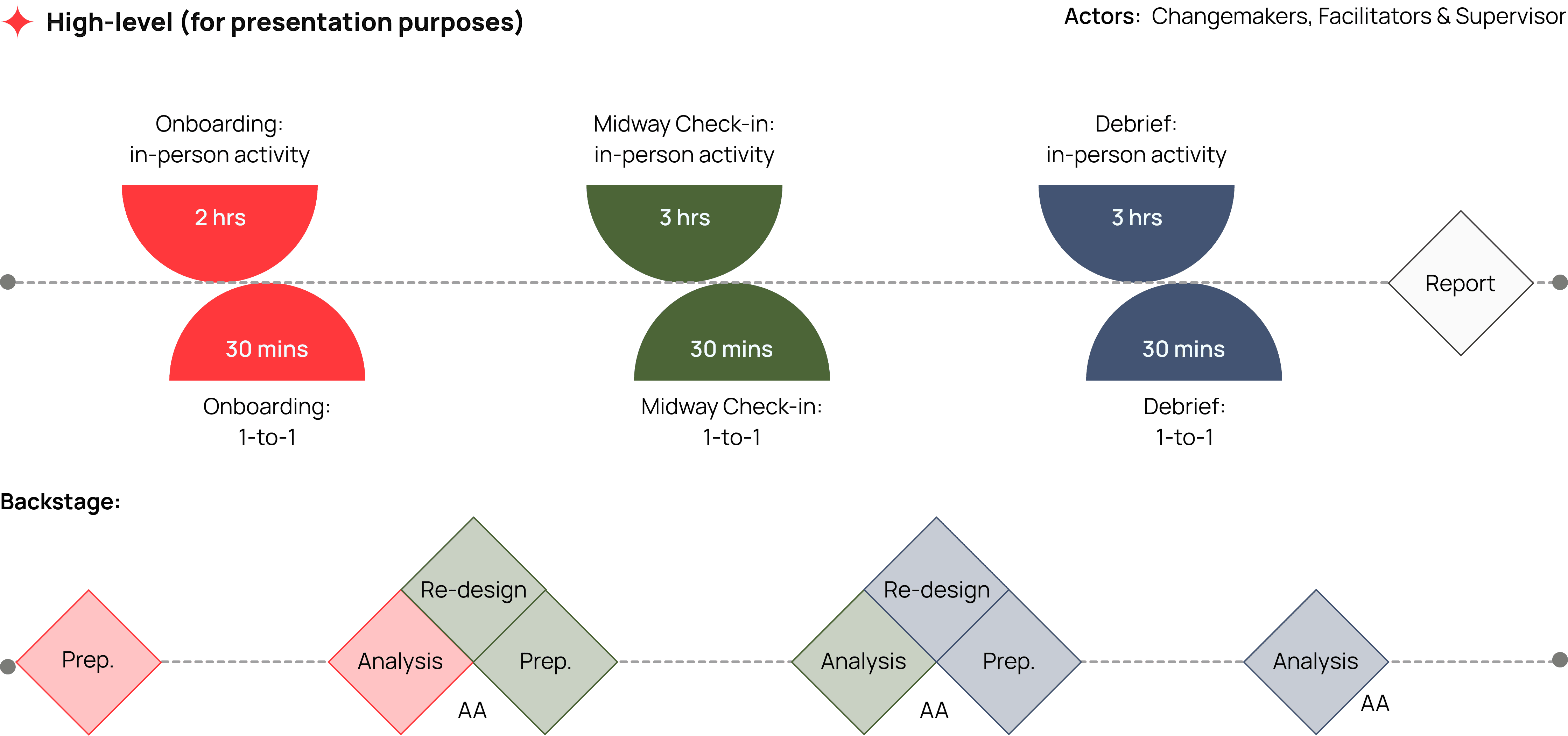
Preparation:
Scheduling, Room booking, Printing & Set-up
Artefact archiving (AA):
Materials stored and revisited as scaffolding during redesign
Analysis:
Evaluation review: deriving evaluation points from documented material
Facilitation review: assessing workshop design, noting what to change
Redesign:
Contextual redesign: adapt to context, apply improvements, run mock sessions

Two decisions followed directly from the blueprint:
First, SEF sessions would be built into the existing programme schedule rather than added on top of it. The onboarding session was embedded into the training module already running in week one. No additional hours required
Second, the socio constraint became a design KPI. Every activity had to leave the student partner with something useful for their own work. If a participant walked out of a session without having gained something for themselves, the activity had not met its own brief.
Funding
The SEF was funded through the UAL Climate, Racial and Social Justice fund. The application was framed around a simple argument: this was capital expenditure, not recurring cost.
The funding covered the design, testing, and documentation of the framework. Once built, the toolkit, facilitation guide, and evaluation templates would be owned by the programme as reusable assets.
The second argument was about institutional value. A justice-focused evaluation methodology, formalised and documented as student intellectual property, creating a knowledge asset.
Outcomes the application committed to:
A robust, reusable evaluation framework
Documented methodology and templates
Cross-departmental collaboration between Changemakers, Academic Support, and IP/Knowledge Exchange
Dissemination of findings
Planning for Impact
Rather than defining success after the fact, the SEF team developed a Theory of Change at the start of the project. This mapped what inputs we were working with, what activities we would run, what outputs those would produce, and which short, mid, or long-term goals they would move towards.
The full goals are published on the
Changemakers website, See Goals (opens a new window)

Input
Changemakers’ lived experiences, identities and feelings
Institutional Support (funding for the programme + secured funding)
Facilitation (structural care) & Expertise (theory-based process testing and frameworks to acknowledge power dynamics)
Brave Spaces (co-created by the cohort and supported by the changemakers self-advocacy)
Activities
Onboarding: Body Mapping, Group Expectations
Midway checking: Participation Ladder, Co-Analysis
Debrief: Embodied Mapping, Participation Mapping, Flower Making
1-to-1 Sessions
Group discussions
Padlet Reflections
Outputs
Creative Artefacts
Reflective Insights
Participatory Reports
Acknowledgement of Collective Action Resources
Acknowledgement of peer-to-peer training opportunities(Figma, funding, Fellowship)

The Theory of Change became a design tool. Every time we designed an activity, we worked through the same logic: What are we asking participants to bring in? What are they producing? And which goal does this connect to?
For Example, Activity 1 from Debrief session, Embodied Journey Mapping takes take Changemaker’s lived exp. as an input and produces reflective insights that builds personal reflection.

04
The Design
Each touchpoint was designed around a core principle from cognitive theory: don't ask people to recall everything at once. Instead, surface one experience at a time, bring it into active reflection with others, and leave with something tangible.
The activity flow across all three touch-points follows the same arc: individual input, group sharing, collective sense-making, and a clear off-boarding.
USER STORY
As a student partner, I do not want to do extra cognitive labour that does not add to my project, so that I could utilise my contracted hours towards my own work.
USER STORY
As a student partner, I want to be recognised for the invisible labour I do, so that I could effectively communicate the range of my contribution
USER STORY
As a student partner, I want to see a clearer picture of how my feedback would bring about change, so that I could be motivated to advocate for my own voice

Every activity was assessed against 7 criteria before it was finalised: HAD2T2C (“Had to Tea to See”)
Heuristic
Be explicit about why, what, and how for every task you design.
Accessibility
Accessibility is contextual, not fixed. Design for who is actually in the room.
Documentation
Build documentation into the session, not as an afterthought.
Transparency
Tell participants exactly what data you are collecting, who sees it, and why.
Time
Respect people's time and plan for the unexpected.
Cognitive Load
Reflection and creation are tiring. Plan your sessions around energy, not just time.
Carbon Usage
Audit your materials. Know what you are using and where it goes afterwards.
Dual Agile Process
The design process was iterative in real time. After each touchpoint, the team ran two parallel reviews: one on the evaluation data (what participants told us) and one on the facilitation (how the session itself went). Changes to the next touchpoint were made before the next session ran.


Outcomes
The project delivered four outputs: a reusable facilitation toolkit, a published evaluation report, a peer-reviewed chapter in Springer Nature (2026), and the framework itself, documented and published on the Changemakers website.


"The evaluations I have experienced before, whether in education, at work, or in society in general, have usually been based on predefined criteria and fixed ideas about what is considered good or successful. In SEF, however, I felt that participants had the freedom to share their own experiences and express their opinions in a way that was supported by their own arguments and reflections. There was no predefined idea of what success or failure was supposed to look like, which made the evaluation process feel much more open, honest, and meaningful."
Sara Keserović, Changemaker 2025-2026
"The SEF is very useful and meaningful for me. Not only because is by students, to students and for students, but also it reshaped my idea about the relationships between students, staff and student staffs. The research framework helped me to better consider my location within a university programme without any pressure, help me to build the courage to behave better and help others, and build a friendships with other colleagues during the whole evaluation process. I am very grateful to take part in the SEF procedures."
Hanjun Shi, Changemaker 2025-2026

Read more about SEF on LCC Changemaker’s official website →