




"I as a cis-woman never realised how something as small as a hair tie, which I keep losing, is in fact in a way an experience of my gender in some way. Not that hair ties are objectively feminine, but perhaps how we subconsciously feel towards these objects."
Participant, Workshop 6, UCL LGBTQIA+ Group, London
PROJECT PARTNERS
MY ROLE
TEAM
DELIVERABLE
Research Structure
Three phases, built on Freirean praxis
Paulo Freire's framework treats knowledge as something generated through lived experience, not delivered from above. I structured the research using three interdependent components of Freirean praxis.
Each phase built on the last. Reflection without action stays private. Action without reflection stays surface. Critical dialogue between people requires both.
The 7 workshops moved through these phases iteratively. Methods that didn't work were replaced. The research itself became the artefact.
01
Reflection
How do people make meaning of their own queer identity? What materials or prompts open that process when language fails?
02
Action
What happens when that meaning is performed or represented? What conditions make it possible to show rather than describe?
03
Critical Dialogue
Can those meanings be shared across difference? What does peer-to-peer exchange between community members actually require?

Word cloud reflection activity: Prompt & still from Workshop 1
Material culture
Embodied methods
Workshop Iterations
01 REFLECTION
From words to objects
Participants identifying daily objects to communicate an aspect of their queer identity
02 action
The Bag Dweller and masks
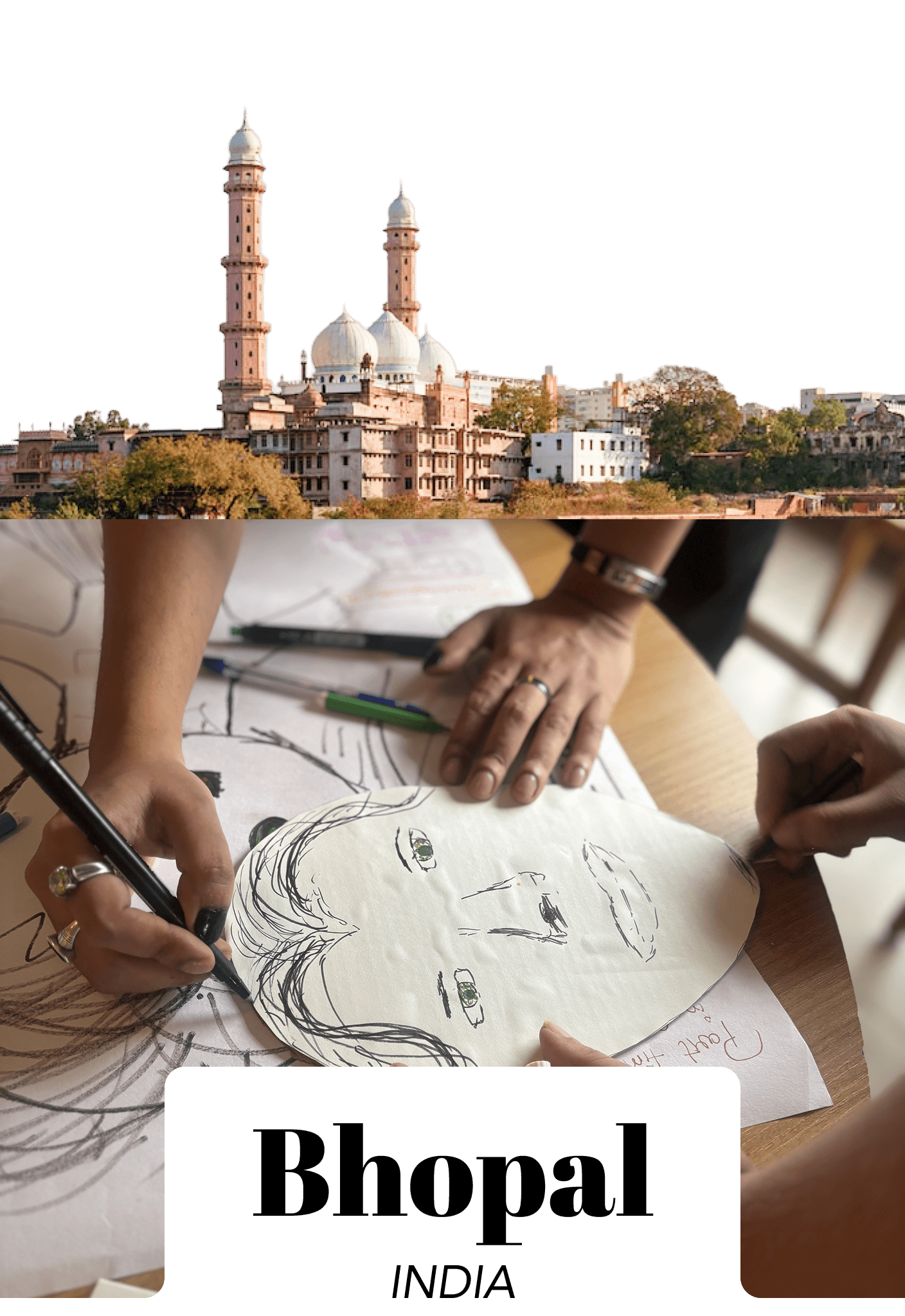
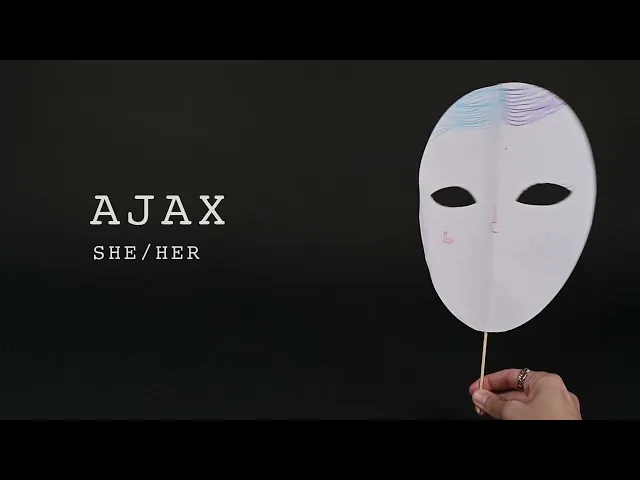
Asking participants to discuss queer identity directly didn't work. Conversations stayed surface-level or stopped. I introduced masks in Workshop 3.
Puppet pedagogy research (Roy 2016; Kröger and Nupponen 2019) describes how masks create protective distance between the self and the performance. They reduce internal shame and allow people to speak from partial anonymity. The mask doesn't hide: it gives permission.
I also developed a character called the Bag Dweller. In Theatre of the Oppressed methodology (Boal), characters with undefined motivation allow participants to project onto them. In workshops, an unnamed character without defined will was interpreted as threatening. Participants mapped hostile motivations onto the figure, drawing from their own experience of being read as dangerous or suspicious.


Giving the Bag Dweller a clear, benign backstory changed everything. Participants explained the character rather than defending against it.
The workshops used two distinct physical spaces: a production room for creation, a theatre space for performance. Keeping them separate gave participants control over what moved between them, and when.
Puppet pedagogy
Theatre of the Oppressed
Character design
Magic circles

03 Critical Dialogue
Reflection after action: the unresolved phase

Design Open Question
What does peer exchange between community members actually require and how much time needs to sit between the doing and the meaning-making?
Material culture
Embodied methods
Workshop Iterations
Methodology
How data was collected, read, and stress-tested

Data Collection
Each workshop generated three types of material: written and audio field notes taken during sessions, recordings of group discussions and facilitated exchanges, and participant artefacts produced during activities, including objects brought in, written responses, and drawings.
These were collected across all 7 workshops in Delhi, Bhopal, and London.

Analysis
I used affinity mapping to cluster patterns across sessions, followed by thematic coding to identify recurring structures in how participants engaged with methods.
Findings were triangulated with participants directly: I shared emerging interpretations with people from the workshops and tested whether the readings held.
Using AI LLMs as critical voices in workshop design
For speculative workshops that couldn't yet be run with real participants, I used AI as a stand-in for critical review. The method: describe the participant persona in detail, share a proposed workshop plan, and ask the model to critique it through two specific lenses: heuristic violations and cognitive load.
This wasn't run once. I repeated the same prompt across multiple LLM agents, then contrasted and compared the outputs. Where models disagreed, that tension itself became a finding. Where they converged, it gave stronger grounds for a design decision.
Persona briefing
Participant background, community context, and positionality fed into each model before critique was requested.
Heuristic & cognitive load critique
Each model assessed the workshop plan for friction points, overload risks, and assumptions baked into the facilitation design.
Cross-model comparison
Outputs from multiple agents were contrasted. Divergence highlighted genuine ambiguity in the design. Convergence strengthened the rationale for decisions made.
What The Research Found
Three things the workshops revealed
Everyday objects as communication tools
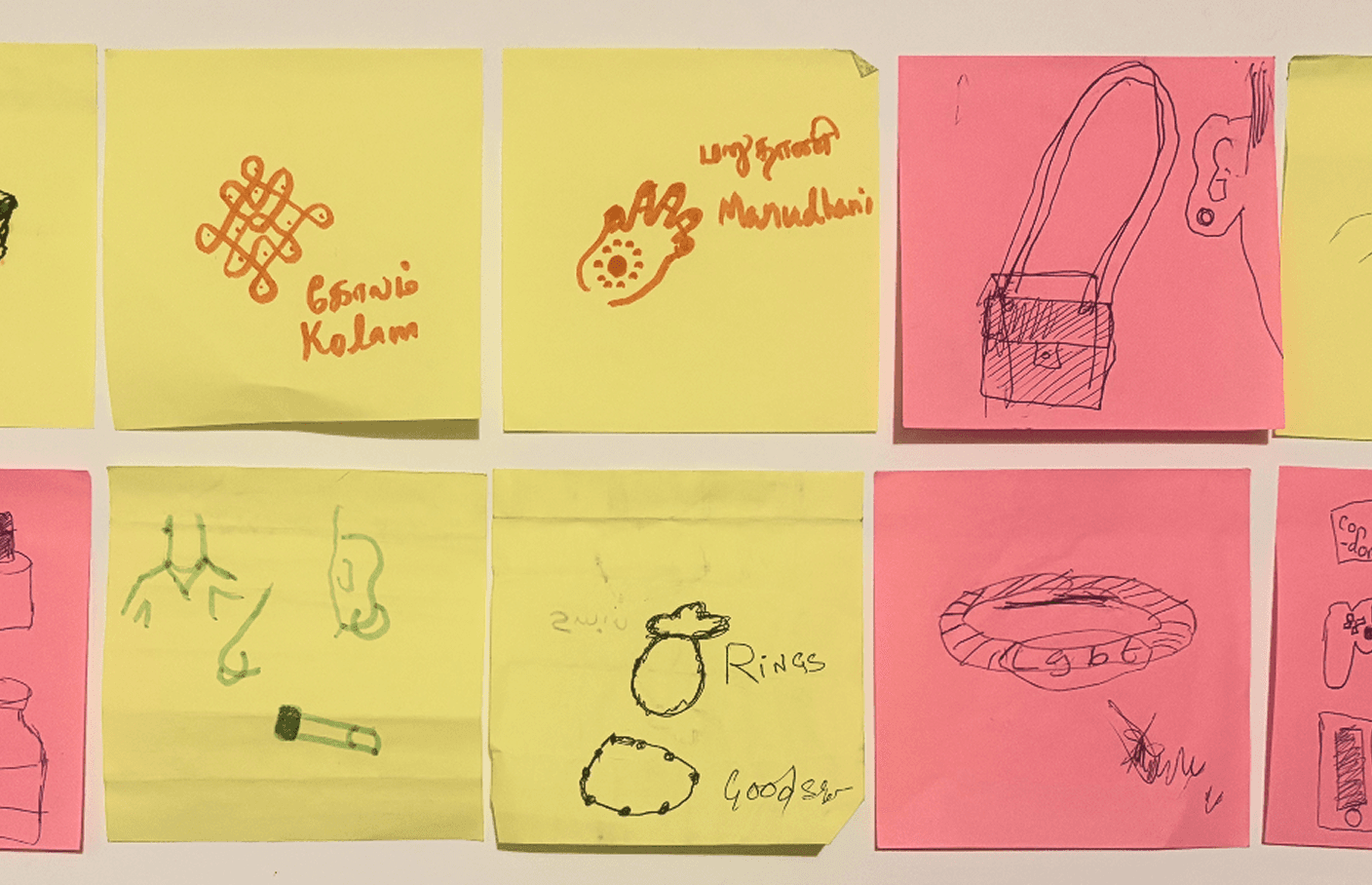
When direct conversation stalled, objects opened it. A dupatta, a photograph, something carried in a bag. Participants could locate their experience in something held, not just described. Material culture carries meaning that language alone often can't.

Clearly defined character "Will" as a condition for dialogue
Undefined characters didn't create openness. They created projection. Participants mapped hostile motivations onto ambiguous figures, drawing from lived experience of how they are read by others. A character with a clear, legible motivation created the conditions for explanation, not defence.

Concrete anchors bridge reflection and exchange
Abstraction closed people down. Objects, characters, spatial separation between production and performance: each anchor gave participants somewhere to start. Movement between reflection and dialogue needed something to hold onto.

"I was listening to how a few people shared that a black nail polish or henna marked their first exploration of queer experience and I wonder if we could do a nail painting or henna event here at the community centre."
LGBTQIA+ non-profit leader, Bhopal
"The rolling pin, henna, kolam or the Indian style earrings are all such common south Asian household things. I am very happy and astonished at how much queerness can be found in our culture."
Participant, Workshop 7, NAZ Project, London

What Was Built
Three research outputs

Character Design
A character with a designed backstory: someone who keeps their most meaningful things in a bag. Paired with masks to create protective distance and reduce shame. Participants could work with the character rather than react against it.

Facilitation Tools
Workshop prompts built around everyday objects rather than language. Designed to open conversation rather than direct it. Each card invites participants to bring something rather than name something.
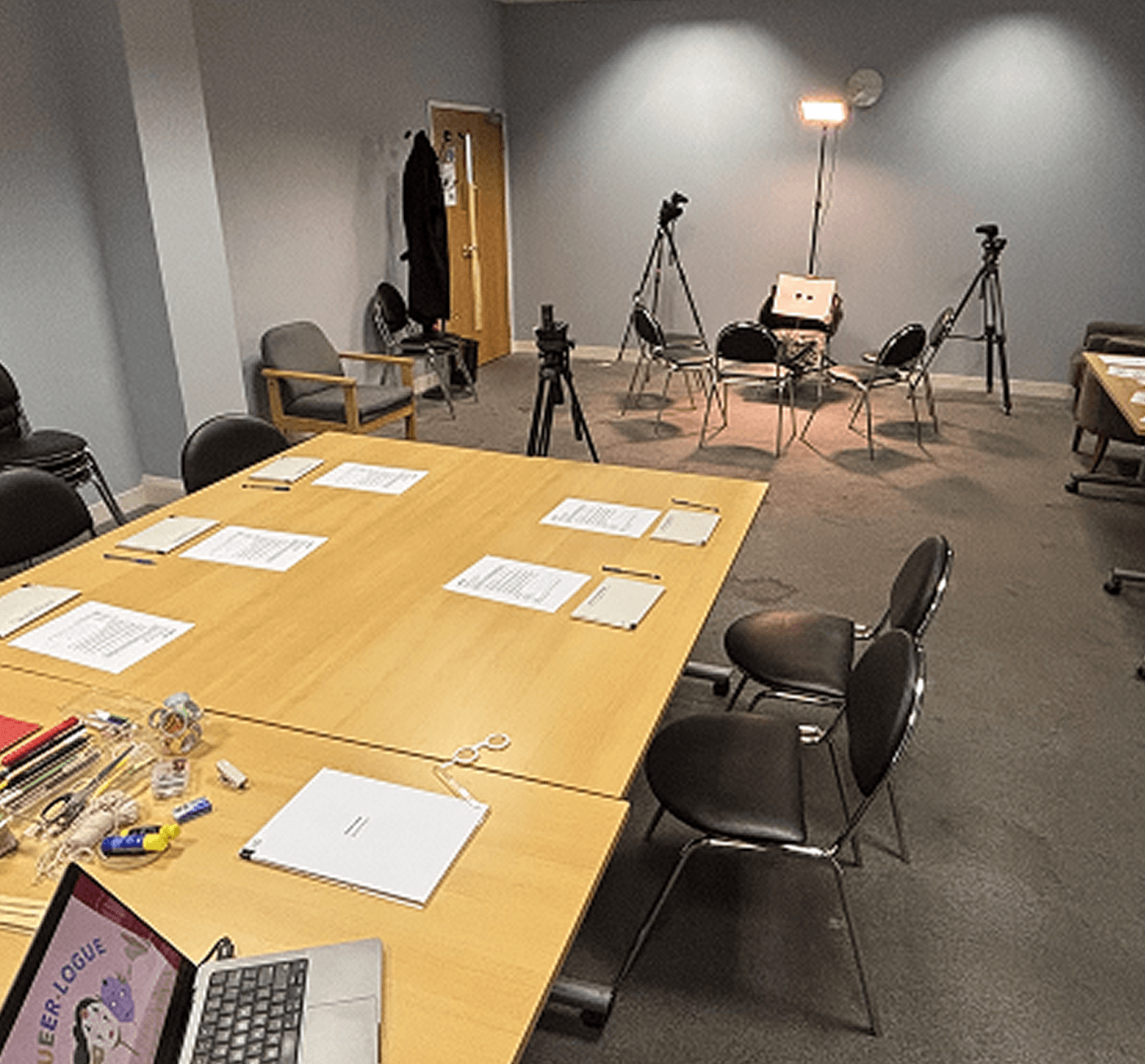
Spatial Structure
A production room for creation and a performance space for sharing, kept physically distinct. Participants controlled what moved between them. Separation created conditions for safety before exposure.