Found Faculty: What if students pick the teachers?

Learning Experience Design
Speculative
UX

A speculative learning experience that re-imagines the student-teacher hierarchy for a globally dispersed cohort. Students explore their physical surroundings to find teachers, tag them, and share what they learned with peers through an open, student-controlled platform.

Found Faculty: What if students pick the teachers?

Learning Experience Design
Speculative
UX

A speculative learning experience that re-imagines the student-teacher hierarchy for a globally dispersed cohort. Students explore their physical surroundings to find teachers, tag them, and share what they learned with peers through an open, student-controlled platform.

"My teacher today is the floor. I spent sometime observing and looking at different floor textures inside and outside, and then I compared to floor pictures from back home. I realised the textures are different. Ones that can trap dust are less in use over in India. That is what I learned today."

UAL Student during user testing

The Project

A learning system where students recruit the faculty

Found Faculty is a speculative UX design project developed in collaboration with UAL Online. It explores what peer-to-peer learning can look like when students have full agency over what they learn, who they learn from, and how they document and share that knowledge. The design moves away from top-down educational structures. Students explore their local environments, identify teachers from the world around them, and tag those teachers for others in their cohort to discover. Knowledge accumulates across physical locations. The cohort builds its own faculty.

Found Faculty is a speculative UX design project developed in collaboration with UAL Online. It explores what peer-to-peer learning can look like when students have full agency over what they learn, who they learn from, and how they document and share that knowledge. The design moves away from top-down educational structures. Students explore their local environments, identify teachers from the world around them, and tag those teachers for others in their cohort to discover. Knowledge accumulates across physical locations. The cohort builds its own faculty.

INSTITUTE

UAL Online

UAL Online

MY ROLE

UX Design & Research, Workshop Design, Facilitation,

UX Design & Research, Workshop Design, Facilitation,

TIMELINE

5 Weeks

5 Weeks

OBJECTIVE

A project based learning experience for a globally dispersed cohort

A project based learning experience for a globally dispersed cohort

The Brief

Design learning for people who refuse the tools most online education depends on

UAL Online wanted to rethink online learning beyond the conventional model. The prompt: design a learning experience for a fictional MA cohort in Anarchism and Activism.

The cohort is globally dispersed. As a point of principle, they refuse centralised platforms. No Zoom, no Google Meet. They are activists who mistrust hierarchical systems, including the infrastructure most online education runs on.
The constraint defined the direction. If mainstream tools are off the table, what does learning look like?

Material culture
Workshop Iterations
Embodied methods

The Problem

A product built for urban, English-literate users was failing a new majority

UAL Online wanted to rethink online learning beyond the conventional model. The prompt: design a learning experience for a fictional MA cohort in Anarchism and Activism.

The cohort is globally dispersed. As a point of principle, they refuse centralised platforms. No Zoom, no Google Meet. They are activists who mistrust hierarchical systems, including the infrastructure most online education runs on.
The constraint defined the direction. If mainstream tools are off the table, what does learning look like?

Material culture
Workshop Iterations
Embodied methods

The Design Question

How is knowledge produced? And how is it shared, without a platform the cohort would trust?

01

01

Metacognition

Understanding what you already know before seeking what you do not. The student maps their own knowledge gaps.

02

02

Action

Engaging with unfamiliar knowledge through a structured task. Learning happens through doing, not being told.

03

03

Reflection

Documenting and communicating what the task revealed. Reflection is made concrete through a chosen format.

04

04

Discussion

Sharing with peers to deepen and challenge the learning. The cycle feeds back into what the student now knows.

The Framework

Anarchism applied to higher education

A university, through an anarchist lens, is a library and a connector. Not an authority. The design needed to commit to that fully: students carry the knowledge, the university provides the infrastructure for exchange.

Drawing from Vygotsky's Zone of Proximal Development, self-regulated learning theory (Brenner, 2022), and scaffolding theory, we identified four components that support genuine independent learning.

Earlier Iterations

Two ideas we tested and moved on from

Knowledge as a map

A self-regulated learning tool where students chart their own knowledge journey. Inspired by the metaphor "knowledge is a journey, not a destination" (Lakoff and Johnson, 2008). In testing, the map made knowledge feel like a destination. Students focused on completing it rather than exploring it.

Result: Turned exploration into completion

The Ledger

A peer Q+A tool inspired by graffiti communication (Leong, 2016): two questions, passed around the cohort. "What do you want to learn?" and "How can you contribute?" In testing, engagement was high but exchange was not. Responses stayed performative rather than dialogic.

Result: Engagement without real exchange

Both concepts failed to create the conditions for genuine peer-driven learning. The problem was not the format. Neither had a strong enough anchor to generate actual knowledge.

Both concepts failed to create the conditions for genuine peer-driven learning. The problem was not the format. Neither had a strong enough anchor to generate actual knowledge.

The Insight

Who is your teacher?

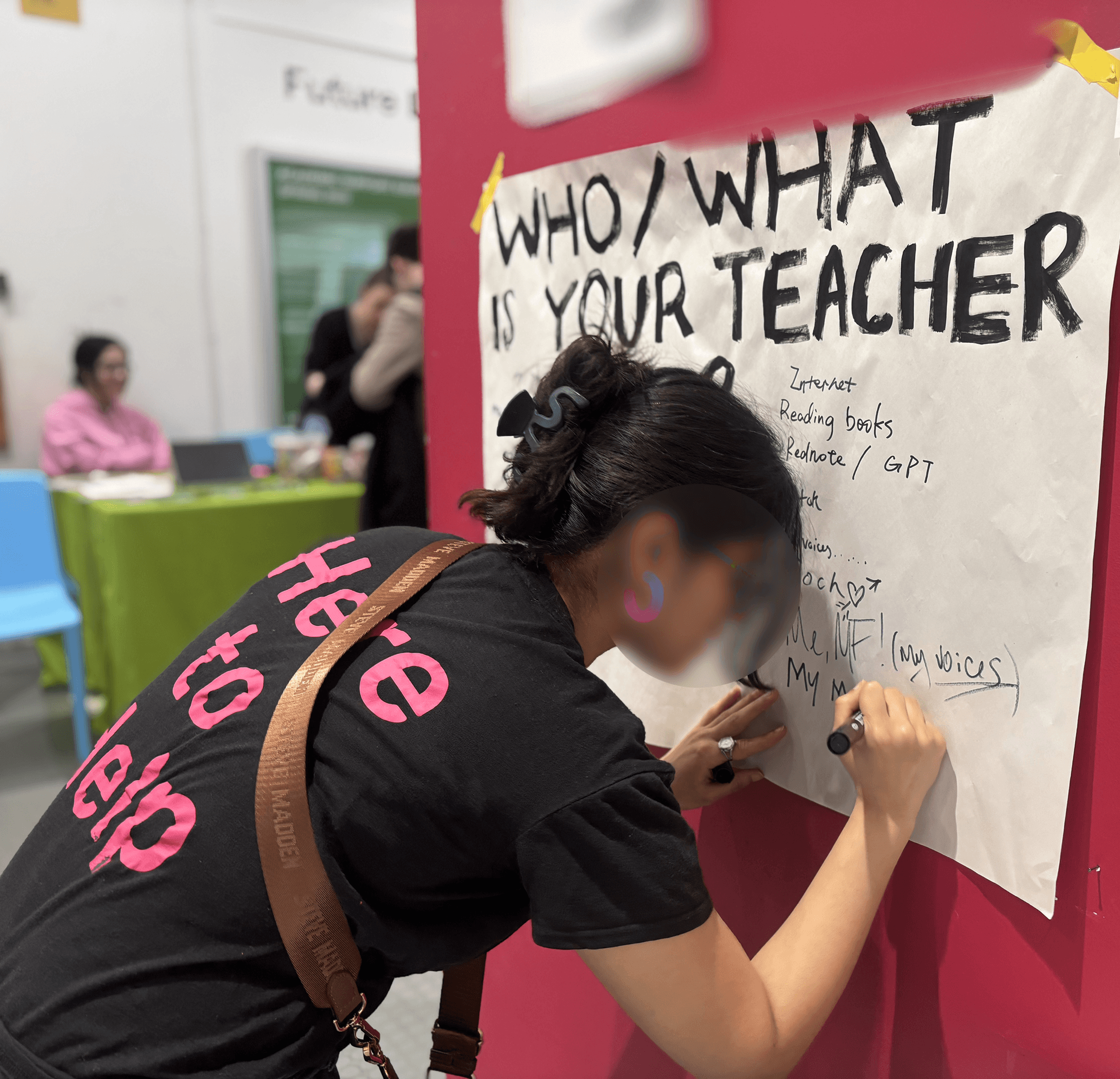
We put one question across LCC's campus: Who is your teacher?

The responses expanded what we thought was possible. Teachers named included parents, strangers, technology, animals, inanimate objects, and natural phenomena. One response referenced how engineers studied mycelium networks to design Tokyo's subway system.

A teacher does not have to be a person.
From that point, the direction was clear: encourage students to go and find their own teachers, wherever they might be.

Non-human teachers
Expanded definition
Student agency

research

The insight came from watching how people used their phones,not the product

We put one question across LCC's campus: Who is your teacher?

The responses expanded what we thought was possible. Teachers named included parents, strangers, technology, animals, inanimate objects, and natural phenomena. One response referenced how engineers studied mycelium networks to design Tokyo's subway system.

A teacher does not have to be a person.
From that point, the direction was clear: encourage students to go and find their own teachers, wherever they might be.

Workshops

Testing the concept with UAL students

"I was just going to write a note but then I saw the effort everyone was putting in, so I decided to explore the documentation more."

Workshop Participant

"The task of having to look for a teacher made me look everywhere. And when I saw someone look at the pigeon, that was also interesting, giving me ideas for where to look."

Workshop Participant

I designed and facilitated two workshops, each with five UAL students at BA and MA level, run on the same day.

Each session followed the same structure: a group discussion on what a teacher can be, a 30-minute solo exploration of the surrounding area, individual documentation of findings in any chosen format, and a group sharing session.

Teachers found across both workshops included a pigeon, a bench, a refrigerator, and a floor. Documentation ranged from written notes to collages to physical models.

Two things became clear. Peer visibility, being able to see each other's process, raised both the quality and ambition of individual work. And the act of physically searching changed how participants related to their surroundings.

The Design

The Design

Four components of the Found Faculty system

Four components of the Found Faculty system

The system connects physical exploration to digital sharing, without depending on any centralised platform. Each component was designed around the learning framework and the cohort's values.

The system connects physical exploration to digital sharing, without depending on any centralised platform. Each component was designed around the learning framework and the cohort's values.

The NFC Tag

Students are given a set of physical NFC tags. When they find a teacher, they tag it. A later student who encounters the same bench, pigeon, or wall can scan the tag and access the previous student's documentation. Knowledge accumulates on a location over time.

The Open Platform

All documentation is uploaded to an open, non-proprietary platform. Any format is accepted: written notes, photographs, audio, collage, models. The platform is the cohort's shared record, searchable and accessible to future students.

The Welcome Kit

When a student joins the cohort, they receive a physical kit: NFC tags, a Teacher Tagger ID card, and the current cohort brochure. The brochure lists the faculty as decided by the cohort so far, updated as new teachers are tagged and agreed upon.

The Fluid Cohort

Membership is not fixed. Students can join and leave. The cohort collectively decides its own faculty. There is no set syllabus. New students enter an existing body of peer knowledge and add to it.

Impact

What the workshops and collaborators observed

"The idea of discovering an alumni's work, past student work built into the system of exploring a subject, can bring about the feeling of community among online cohorts, which is something they miss out on."

Ian Trulove, Research and Innovation Coordinator, UAL Online

"Recruiting teachers feels rebellious and fun. The thought and discussions around why a non-human should be faculty, held with peers, could surface many individual observations that would otherwise go unshared."

UAL Student

Create a free website with Framer, the website builder loved by startups, designers and agencies.