


COMPANY
MY ROLE
TEAM
DELIVERABLE
The Problem
25% of learners were dropping off a path that was designed to hold them


The Framework
Why knowledge space theory, not just adaptive sequencing
Research
Two users. Two completely different needs. One solution.
Online video call interviews with children from Kindergarten and Grade 1 (75% of the user base), followed by separate interviews with their parents. Each child completed a 5-game adaptive session while I shadowed and took observational notes.
01
Children
Variety to sustain attention.
Celebration to sustain motivation.
After an initial peak of interest, learners found the path monotonous around games 5 and 6 and clicked off. When they beat games of increasing difficulty, they expressed genuine delight and shared it with their parents proudly.
Need: Break + Celebrate
02
Parents
Transparency over the algorithm.
Involvement over automation.
Parents did not trust the algorithm to manage their child's progress unsupervised. They wanted to know when games were being skipped and why.They frequently asked children to repeat skills rather than move on.
Need: Visibility + Control
These two sets of needs pointed toward the same solution: a structured moment of challenge and visibility, appearing at the right point on the adaptive path.

Break Monotony
A distinct experience with different rules, stakes, and rewards pulls the learner out of the routine path at the right moment.

Celebrate Achievement
Challenge Mode only appears when the learner is performing well. It is earned, not imposed — which is what makes it feel like an achievement.

Surface Revision
It draws on skipped games and weaker skills, testing real gaps rather than reinforcing what the learner already knows.

Parent Checkpoint
Parents can review performance across multiple skills in one session, without needing to track individual games on the adaptive path.
The Octo mechanic
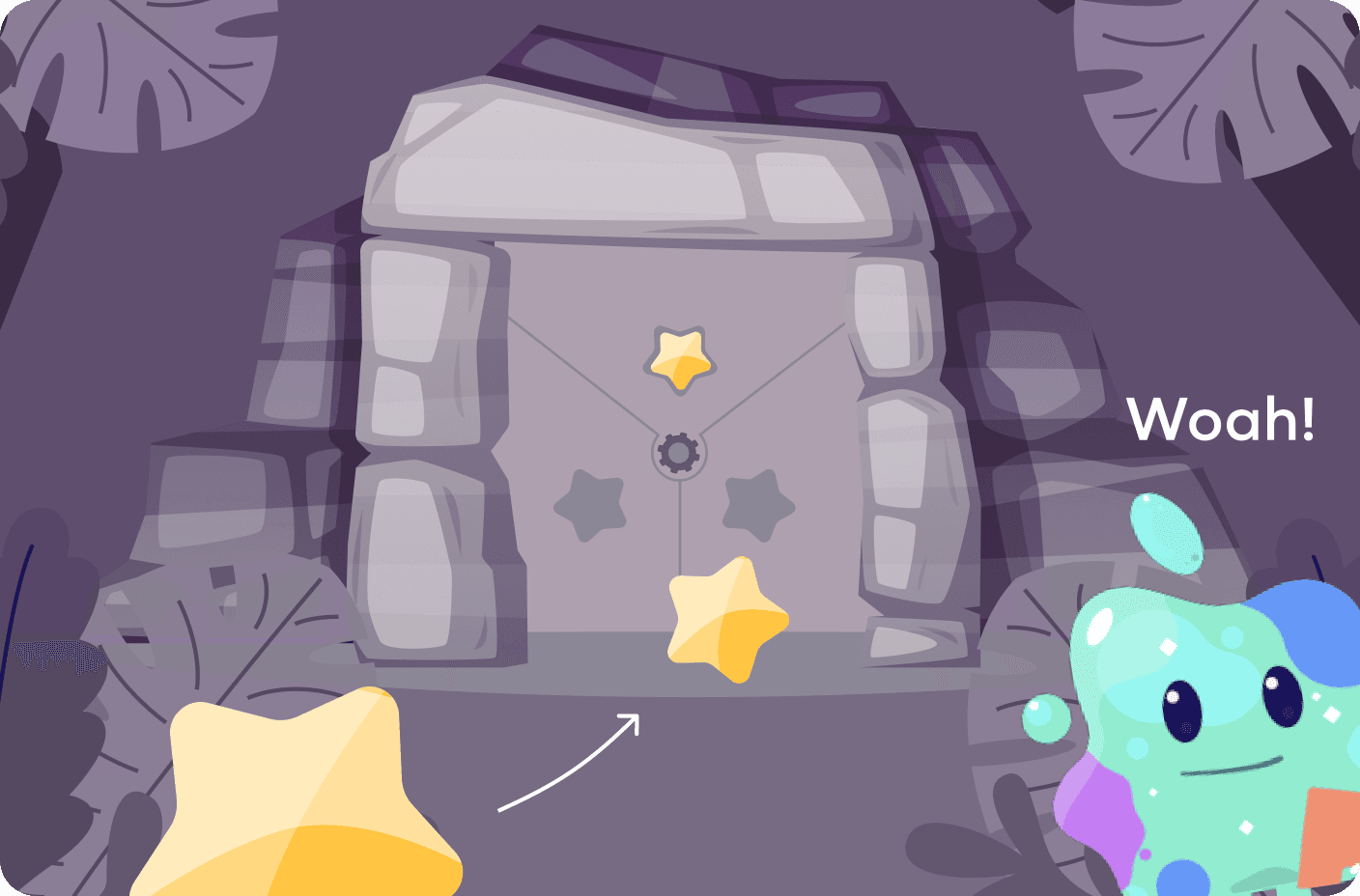
Themed around "Challenge Cave" with an octopus character named Octo. Lose, and Octo offers one more chance at a cost. Win, and the whole treasure chest is yours
Variations:
Age 2-4 (EYFS): Rewards only, no timer
Age 5-7 (KS1): Visual Timer: Finish before Octo reaches the button
Age 7-8 (LKS2): Countdown Timer
Age 9-11 (LKS2): Countdown timer & streaks


outcome
The brief was a 10% reduction. The finding was bigger.
What the results revealed
The more significant finding was behavioural: children on the adaptive path did not stick to linear sequences even when the path adapted to them. They explored, revisited, and moved laterally. This informed a conversation with the product team about designing for that behaviour rather than against it.
The result was the daily learning path feature:
An adaptive sequence presented as a daily quest, removing the expectation of linear completion entirely. Instead of increasing retention for the day, the learning path focuses on bringing players back the next day for a new path.

